1. Hard water: scale decides how long a cartridge lasts
Groundwater, borehole and some municipal supplies carry high mineral content. Limescale builds inside poorly made taps, restricts flow and shortens cartridge life; in coastal and some inland areas, saline or mineral-heavy water attacks the finish as well.
What to specify:
- Solid brass bodies, not zinc alloy. Brass holds threads, tolerates heat cycling and takes plating far better than cheap alloy. Zinc-alloy fittings finished to look like brass or stainless steel are a known problem in several markets, and peeling finishes and seized handles are the usual result. A quick field check some buyers use: brass is noticeably heavy and a magnet will not grip it; steel-based fakes often will.
- Ceramic disc cartridges, with a replaceable part number. Ask for cycle-test data and confirm the cartridge is a stocked spare, not a proprietary disposable part.
- Serviceable aerators and silicone nozzles. Easy-clean silicone jets on rain heads and hand showers let the end user wipe scale off instead of replacing the head.
- Verified finish testing. Ask for the plating process (electroplated or PVD) and salt-spray test hours, not just a colour name.
Commonly referenced standards for mechanical mixers and ceramic-cartridge taps include EN 817, EN 200 and EN 246. The standard accepted in your destination market is set by that market's regulator and your appointed inspection agency — confirm it before testing, because a report to the wrong standard usually means re-testing.
2. Pressure: a roof tank changes everything
In many cities, a home, guesthouse or small hotel is fed by a roof tank, a ground tank or a borehole with a booster pump — not by a stable pressurised main. Gravity-fed supply gives low pressure. Pump-fed systems can give high and fluctuating pressure. A thermostatic mixer or a large rain head specified for a pressurised main may perform poorly on a gravity system, and an instantaneous water heater on low pressure paired with pumped cold water will make any mixer struggle to hold temperature.
What to do:
- Record the supply arrangement at measurement stage — tank, borehole, mains or pump — and put the available pressure in bar into the purchase order. This one line prevents most post-installation complaints.
- Confirm the minimum operating pressure of both the mixer and the shower head, and ask whether a low-pressure-rated cartridge or aerator is available for the model.
- Balance hot and cold supplies, or choose a heater that suits the system. On oversized pumps, fit a pressure-reducing valve.
- For concealed and thermostatic sets, confirm rough-in depth, wall build-up and the position of the tub spout before the wall is closed. Concealed bodies are the most expensive items to correct after tiling.
It is far cheaper to specify the right cartridge up front than to replace forty mixers on a finished site.
3. Climate: coastal salt, humidity and dust
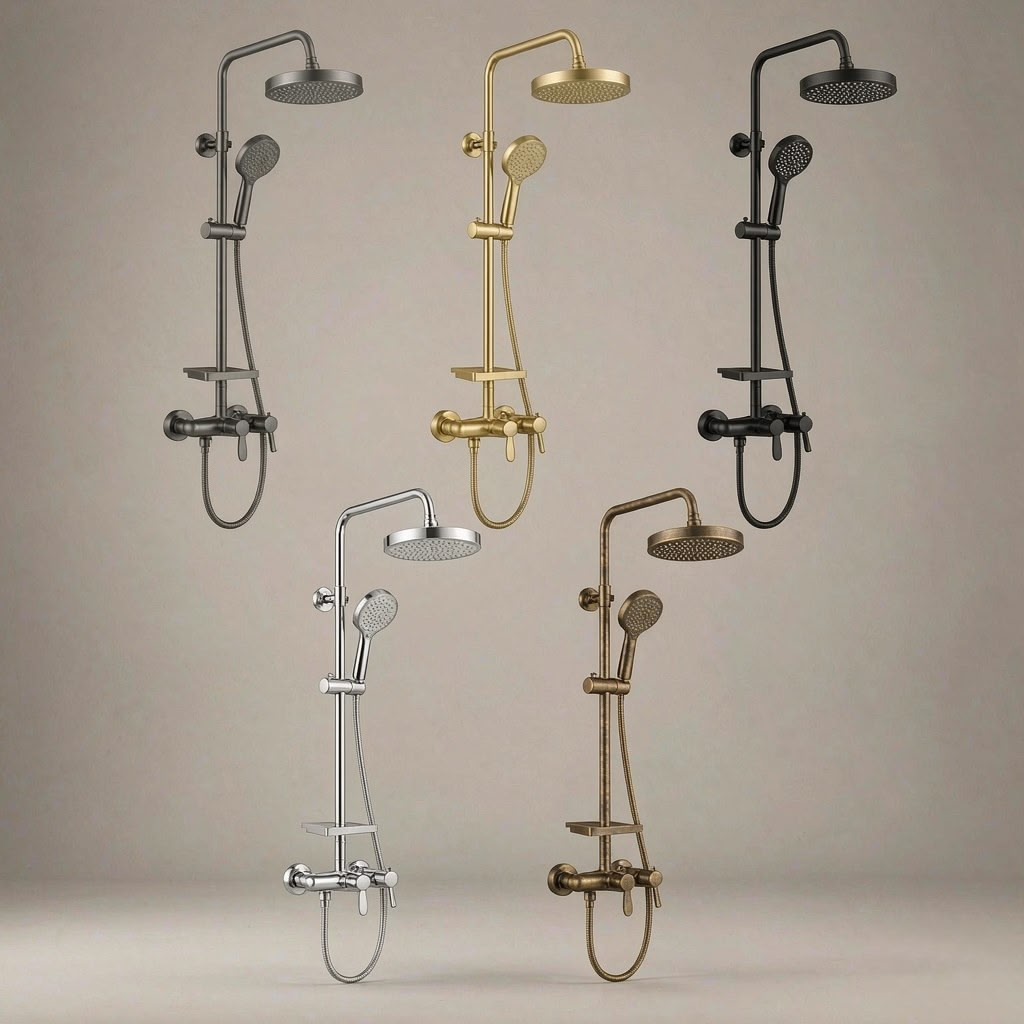
Ordinary chrome plating can pit and discolour quickly under salty or mineral-heavy water. Design-led finishes — gun grey, brushed gold, brushed nickel, matte black, antique brass, polished gold — are in demand for showrooms and hospitality, but they only hold up if the plating process is right.
Ask your supplier:
- Whether the finish is electroplated or PVD, and the plating thickness
- Salt-spray test hours for that specific finish, not a generic claim for the range
- Whether the same finish is available across the whole set: mixer, rain head, hand shower, slide bar, shelf, bidet spray gun, basin faucet and accessories. A project that cannot match finishes across rooms looks unfinished.
- Whether batch-to-batch colour consistency is controlled, and how an approved sample is kept as reference
For rental units and busy commercial washrooms, easy-clean finishes are worth the small premium — they reduce maintenance calls over the life of the installation.
4. Compatibility: the fittings have to connect to local plumbing
A technically good shower set still fails if it does not screw onto the local pipework. Confirm these before ordering:
- Thread standard. Many African markets use BSP-threaded fittings; confirm the brassware, flexible connectors and angle valves are BSP rather than NPT.
- Waste and outlet sizes, WC outlet type, floor drain position and shower tray outlet relative to the drain.
- Angle valves and connectors — supply them with the set where local sizes differ.
- Water heater connections and electrical rating where a digital or thermostatic product is involved (commonly 230 V / 50 Hz, but verify locally).
- Spare cartridges, seals, hoses and spray heads in stock from the first order. Spare-parts availability is one of the strongest arguments you can make against cheap imports in a tender.
5. A specification checklist to send with your enquiry
Item | What to confirm | Why it matters |
Body material | Solid brass, with composition declared | Corrosion resistance, thread integrity, resale reputation |
Cartridge | Ceramic disc, part number, cycle-test data | Service life and spare-part availability |
Finish | Process, plating thickness, salt-spray hours | Resistance to salt and mineral-heavy water |
Operating pressure | Minimum bar for mixer and rain head | Avoids weak flow on gravity-fed systems |
Supply type | Tank / borehole / mains / pump | Determines cartridge and heater compatibility |
Thread standard | BSP or NPT | Avoids on-site rework |
Included components | Hoses, angle valves, shelf, spray gun | Prevents missing parts at installation |
Packaging | Carton ply, foam protection, drop test | Reduces breakage claims |
Documentation | Test reports, ISO 9001, spec sheet, COO | Needed for pre-shipment conformity assessment |
Spare parts | Kit list and reorder terms | After-sales capability and tender scoring |
6. Seven questions to put to any supplier
1.Is the body solid brass or zinc alloy, and can you provide the material composition?
2.Which cartridge is used, what is its life-test data, and is it a stocked spare?
3.What is the minimum operating pressure for this mixer and this rain head?
4.Which finish process is used, and how many salt-spray hours has that finish passed?
5.BSP or NPT threads, and are angle valves and hoses included in the set?
6.Can I get this finish across the full bathroom range for a matched project?
7.Which spare parts ship with the order, and can they be reordered separately?
A supplier who answers all seven in writing, with documents attached, is usually a supplier who will still answer the phone after the container arrives.
7. Getting the specification right for your market
Conditions vary city by city — a borehole-fed property inland and a coastal apartment supplied from a roof tank need different configurations. Tell us your destination, water source and pressure range, and we will recommend suitable configurations from our faucet, shower set and bathroom accessory ranges, then prepare a specification sheet and samples for your own testing before you place a volume order.
Next step: send your market, water source and pressure range to our team and request a specification sheet and sample set. Contact Us: seamanzhang888@gmail.com
Related reading: [Post 2 title — import documents and landed cost].
Frequently asked questions
Which faucet material handles hard water best? Solid brass bodies with ceramic disc cartridges generally cope with limescale and daily use better than zinc-alloy alternatives. Regular descaling and easy-clean nozzles extend service life further.
Will a large rain shower work on low pressure? Not always. Confirm the minimum operating pressure of both the mixer and the head, and specify a low-pressure-rated configuration or a booster pump for gravity-fed supplies.
BSP or NPT — which thread standard should I order? It depends on the plumbing practice in your market; BSP is widely used across many African markets. Confirm with a local plumber or distributor before ordering, and state it in the PO.
How can I spot a zinc-alloy fitting sold as brass? Weight and a magnet are common field checks, but they are no substitute for a declared material composition and a test report from an accredited laboratory.